Running client stores shouldn’t feel like managing a side business inside your business.
Yet for many distributors, that’s exactly what happens.
Inventory sitting on shelves.
Manual order routing.
Sales tax questions you didn’t sign up for.
One-piece requests that disrupt your day.
As more distributors explore promo distributor platforms, the real question isn’t “Which one has the nicest interface?”
It’s:
Which platform actually reduces operational friction – without shrinking your margins?
Because the wrong system doesn’t just slow you down.
It quietly increases admin hours, absorbs cash flow into inventory, and turns stores into maintenance projects instead of revenue assets.
The right platform should do the opposite.
It should eliminate inventory risk, automate fulfillment, manage compliance, and allow you to say “yes” to small orders without creating extra work.
In this guide, we’ll break down the top features promo distributors need when choosing platforms – so you can evaluate your options based on profitability and scalability, not just convenience.

1. Inventory-Free Print-on-Demand Infrastructure
If you’re evaluating promo distributor platforms, this is the first filter.
Do they require inventory?
Because inventory is where most store problems begin.
Traditional company stores often mean:
- Buying upfront
- Forecasting demand
- Holding stock for 12-36 months
- Liquidating leftovers
- Managing reorder cycles
That’s cash flow tied up in apparel and drinkware instead of growing your business.
And increasingly, clients are asking:
“Why are we still holding inventory?”
A true print on demand company store eliminates that question entirely.
Wondering why this is so important? I wrote an article on how print on demand is revolutionizing the promotional product space.
What You Should Look For
Not all platforms claiming “print on demand” are equal. Some still require minimums or batching.
The right infrastructure should include:
- True 1-piece order capability
- No minimums
- On-demand decoration and fulfillment
- No warehousing required
- Automatic routing to production
If you still have to manage stock levels, manually trigger reorders, or forecast sizing quantities – it’s not fully on-demand.
Why This Matters Strategically
Inventory risk impacts three core areas:
- Cash Flow – Money tied up in unsold merchandise
- Client Friction – Awkward conversations about leftover stock
- Scalability – Every new store increases operational complexity
An inventory-free model flips the equation.
Instead of asking,
“How much should we buy?”
You ask,
“How many stores can we launch?”
That’s a completely different growth conversation.
And as corporate buyers shift toward flexible, on-demand solutions, platforms built around inventory-heavy workflows will continue to create resistance.
When comparing promo distributor platforms, this is non-negotiable.
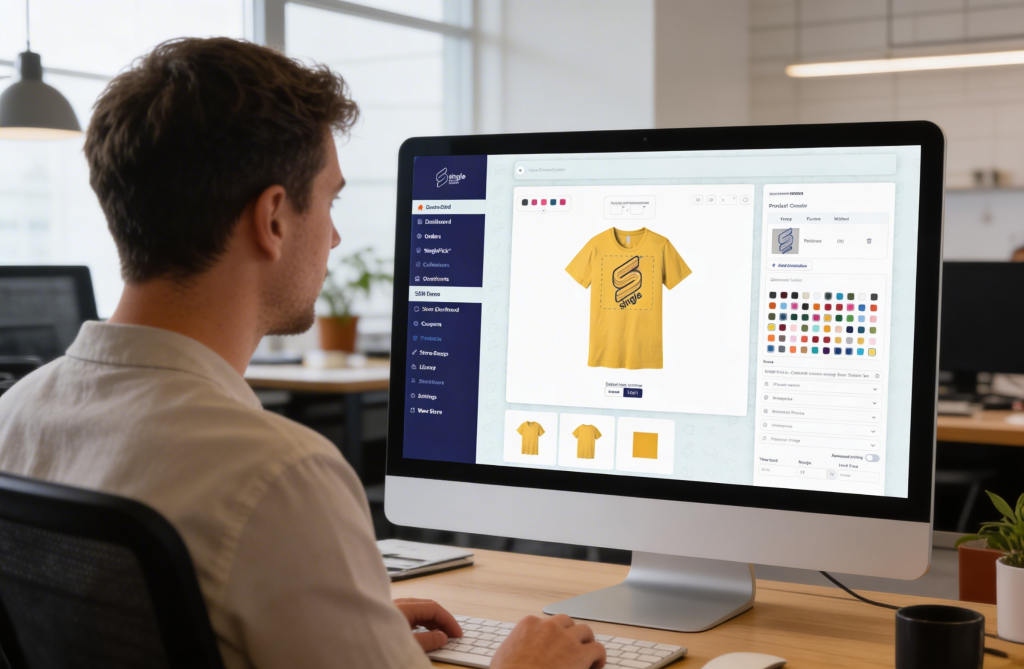
2. Workflow Efficiency: Product Selection Without the Spreadsheet Chaos
One of the most underestimated pain points in company store software is product selection.
Most distributors still gather product ideas through:
- Long email threads
- PDFs
- Manual spreadsheets
- “Can you swap this SKU?” revisions
- Back-and-forth logo confirmations
That friction compounds fast.
A strong promo distributor platform should reduce client selection from days to hours.
Look for Integrated Product Selection Tools
Instead of exporting catalogs into spreadsheets, the platform should allow you to:
- Present curated options directly inside the system
- Allow clients to approve selections digitally
- Eliminate SKU confusion
- Move from idea → live store faster
When product selection is streamlined, stores launch quicker and feel more professional.
Operational speed becomes a competitive advantage.
If you’re evaluating platforms and product selection still feels manual – that’s friction hiding in plain sight. That’s why a product selection tool is one of the top features promo distributors need on their platform.
3. Built-In Monetization Features (Beyond Just Selling Merch)
Most distributors evaluate platforms based on logistics.
Few evaluate them based on revenue expansion.
But modern promotional product ordering platforms should support more than simple ordering.
They should support programs.

Gifting & Recognition Automation
HR departments increasingly want:
- Employee recognition programs
- Anniversary gifting
- Onboarding kits
- Holiday campaigns
A platform with built-in gifting automation allows clients to implement these programs without you managing reminders, logistics, or manual tracking.
The more turnkey it is for them, the more recurring revenue it creates for you.
Fundraising & Proceeds Sharing
Some stores aren’t just for internal merchandise.
They’re for:
- School programs
- Team fundraising
- Nonprofit campaigns
- Community initiatives
A platform that supports fundraising – and manages proceeds distribution – reduces financial admin on your end.
Instead of tracking donations manually or reconciling payments in spreadsheets, the system handles distributions and reporting.
That opens up entirely new verticals for distributors without increasing operational overhead.
4. Hybrid Store Flexibility: Print-on-Demand + Custom Programs
Another overlooked feature in promo distributor platforms is flexibility.
Many systems force you into one model:
- Either print-on-demand
- Or bulk programs
- Or custom fulfillment
But distributors don’t operate in one lane.
You may want to:
- Sell custom high-margin products
- Combine inventory-based items with POD
- Fulfill specialty goods
- Run limited campaigns
The right company store software should allow:
- Custom product uploads
- Combined fulfillment models
- Easy pricing control
- Margin protection
Flexibility protects your ability to serve both small accounts and enterprise clients from one system.
5. Strategic Partnership (Not Just a Login Portal)
This is rarely listed as one of the top features promo distributors need, but it should be.
Many platforms give you software and disappear.
But distributors evaluating online company store solutions should ask:
- Do they help vet store opportunities?
- Do they advise on store strategy?
- Do they help structure programs?
- Do they assist with refresh cycles?
Technology matters.
But partnership determines long-term store success.
The best promo distributor platforms don’t just provide infrastructure – they operate as strategic partners helping you build productive, sustainable stores.
Because software alone doesn’t create momentum.
Execution does.
Conclusion: Choose Infrastructure, Not Just Software
Promo distributors don’t lose accounts because they lack stores.
They lose momentum because their stores create friction.
Inventory risk.
Manual product selection.
Administrative drain.
Programs that feel complex instead of scalable.
When evaluating promo distributor platforms, the goal isn’t to “add a store solution.”
It’s to build infrastructure that:
- Eliminates inventory risk
- Simplifies client collaboration
- Supports gifting and fundraising programs
- Manages proceeds and compliance
- Operates with you – not against you
The right platform should expand what you can confidently offer, while reducing how much you personally manage.
If you’re currently comparing options – or exploring Shopify-style setups – start by reviewing what a purpose-built system for promo distributors looks like.
👉 Explore how Single Serve Merch works
or
👉 Read our breakdown of the best Shopify alternatives for promo distributors
Make your next store launch easier than your last one.